
The difference between the Sunni and Shiite Muslims and why it matters to Missionaries

Wrong, and both groups would likely agree on that point. Neither is it true that all Muslims are the same. Of the over 1.5 billion Muslims in the world, around 85 percent of them are a sect called Sunni and 15 percent of them are a sect called Shia.

The split is an ancient one—1,387 years old, to be precise. But even today, it threatens the stability of the entire Middle East and offers context to many headlines we see in world news.

So how did this world religion end up with two major sects? It all started when Muhammad, the prophet and founder of Islam, died.

The Dispute Over Muhammad’s Successor

When Muhammad died in AD 632, a great dispute arose over who would claim his position as the leader of the new religion. Islam was more than a private religion—it dictated social and political events. The successor to Muhammad would have powerful influence over society, government and trade.

Some people thought anyone with qualifications could take over. These were the followers of “the way” (sunna) of Muhammad, and they became known as Sunni Muslims. They insisted Muhammad’s father-in-law and friend Abu Bakr take control.

Others believed that only someone from Muhammad’s family would be the rightful leader. This camp favored Muhammad’s cousin and son-in-law, Ali ibn Abi Talib, and they became known as the shi’atu Ali (“party of Ali”), or Shiite Muslims.

In the end, the majority Sunni sect got their way and Abu Bakr became the first official successor, or caliph, to the prophet Muhammad. Even so, the Shiites did not recognize Abu Bakr as legitimate and held fast to their conviction about their allegiance to Muhammad’s descendants whom they called Āl al-Bayt, the “family of the house.”

The Shiite-favorite Ali had two sons named Hasan and Husayn. After Ali and his son Hasan’s deaths, Husayn took over as the spiritual leader of Shiite Islam until AD 680 when he was killed by Sunni Muslims during a battle in Karbala, Iraq. This battle and the death of Husayn is a bitter memory for Shiite Muslims. Even centuries later, this martyrdom and the issue of rightful leadership over Islam is still the heart of the Sunni-Shiite divide.


Similarities and Differences in Religious Practice

Both sects maintain the foundational beliefs and practices of Islam. They uphold the Qur’an as the revelation of Allah and hold to Islam’s Five Pillars: giving to the poor, fasting during the month of Ramadan, practicing daily ritual prayers, taking the pilgrimage to Mecca, Saudi Arabia, and professing that there is no God but Allah and Muhammad is his prophet.

Shiite Muslims complete all five daily ritual prayers but squeeze them into three sessions instead of five. When they prostrate for prayer, Shiite Muslims place their face on a clay tablet called a turbah. Many of these tablets are inscribed with the names of Husayn or others from the prophet’s family. For Shiite Muslims, revering the “family of the house” brings you closer to God. Shiites also hold to 10 obligatory acts beyond the basic Five Pillars.

The loss of Husayn and the leadership of Muhammad’s family cast an enduring hue of sadness over Shiite Muslims. They live in mourning, wearing black most of the year. One of the biggest Shiite holidays is the anniversary of Husayn’s death on the holiday named Ashura, the 10th day of the Islamic month of Muharram. On this day, Shiite Muslims in the Middle East and Asia parade in the street, chanting laments at the death of Husayn, wailing loudly and beating themselves. Some even flail themselves with chains and cut their own heads with swords.

The city of Karbala in Iraq is a pilgrimage site for Shiite Muslims, many of whom sell everything they own to visit this sacred battleground. In many locations, they even reenact the battle, believing that the recognition and reenactment of the battle at Karbala gets them closer to God. These commemorations are not limited to the Middle East. Shiite Muslims around the world—even in the United States—remember their troubled past and slain leader.

Sunni Muslims find the Shiite obsession with the house of Muhammad to be a false Islam that places undue veneration on the prophet’s family. Likewise, Shiite Muslims feel Sunnis are not true Muslims. Their sharp disagreements, unreconciled for centuries, result in a fractured Middle East and perpetually unresolved tension.
 

Shiites and Sunnis on the Modern Map

Saudi Arabia and Iran are the leading powers of the two branches of Islam. The heart of Sunni Islam is Saudi Arabia, the birthplace of Islam. Iran is primarily Shiite and has been led by a Shiite Supreme Leader since its Islamic Revolution in 1979. The power play of these two countries causes constant friction within the Middle East.

Some countries in the Middle East have significant numbers of Islamic sectarian minorities. Saddam Hussein was a Sunni dictator in a largely Shiite country. After his death, reports surfaced that some Shiite Muslims present at his death danced and recited their Shiite chants in victory that they had again claimed the land of Iraq. Bahrain currently has a majority-Shiite population yet is led by a Sunni government. Various uprisings over the years complicate attempts to keep peace in the Middle East.

Understanding these tensions is a significant key to unlock headlines that describe ongoing conflicts and tensions among Muslim sects. But it’s not just in the Middle East. Shiite and Sunni Muslims live around the world—perhaps even in your own neighborhood.


Building Meaningful Relationships With Shiite and Sunni Muslims

So how should we engage our Muslim friends and neighbors in light of this context?

First, understand that most Shiite Muslims view themselves as the oppressed minority. Even fervent Shiites who complete the pilgrimage to Mecca often face mistreatment in Saudi Arabia by majority-Sunnis. This should inform our prayers. Pray that those who feel they are oppressed will understand the freedom and peace that comes through faith in Christ.

Second, show practical love to all. Whether Sunni or Shiite, all Muslims living in America are minorities. Kindness can look like showing new neighbors where to shop or where the nearest park is. Simple acts of love can go a long way in changing the way Muslims think about Christians and their Savior. Muslims are now observing Ramadan, the Islamic month of fasting, until June 4. Consider inviting Muslims you know to break their fast at your house for an evening meal.

Third, remember that only the truth about Christ sets us free from bondage to sin. Many Muslims approach conversations confident in their ideas against the gospel. You may find your Sunni friends, for example, quick to attack basic Christian beliefs like the authenticity of the New Testament. Yet when we lovingly share the truth of Christ, they have the opportunity to receive freedom as the Spirit opens their hearts.


We celebrate that truth. It’s the truth of a sinless Savior who took the punishment for our sins so all who trust in him for salvation can be forgiven and received into the family of God. And it’s this good news that unites the church in a call to love, a call to go, and a call to proclaim its truth among all Muslims—Sunni and Shiite.

Source: Churchleaders.com 

Read more

Raising a family on the missions field

Raising a child is one of the greatest responsibilities bestowed upon a married couple. The responsibility becomes ardours when the parents have to raise their children on the mission field.  The tendency to neglect the family in favour of the missionary work is very high because the missionary work is very demanding. It is not only parents on the mission field who encounter these difficulties, pastors in the local churches and people who occupy leadership positions in the church also face these difficulties.

It is sad to say that some children who grew up with missionary parents became bitter and angry with God because of the neglect they suffered as children. It is never the will of God to break up a family unit for missionaries because sometimes it is the children that God will use to continue or preserve the missionary work of the parents. God counted the descendants of Abraham as an integral part of the fulfilment of His divine purposes and thus God expected Abraham to direct his household in the ways of the Lord. (Gen 18:19). In the same way, God also counts the children born to missionary parents as an integral part of their calling and they must not be neglected. 

Missionary parents must appreciate the fact they are the first representation of God which their children experience. The nature of the relationship which these children will have with God largely depends on the image of God which these children see in their parents. Missionary parents must also appreciate the fact their lives are the godly example for the people they disciple on the mission field. How they raise their children and maintain the family unit has a great impact on these people. Indeed, the missionary may be hindered, if the family unit of the missionary is neglected (1Tim 3:5).

Here are a few tips on how to be a better parent on the mission field

  • Have a family quiet time– Most Christian families are very familiar with having quiet times. But for a missionary family that is constantly on the move, these special moments when the family gathers to pray and study together becomes critical for the survival of the family unit. It becomes a time when the parents can interact with the children without outside influence. It also affords the children an opportunity to bond with their parents. The missionary parents must carefully plan these special moments with the family to get the best out of these times.
  • Delegate missionary activities if possible– zeal for the work of the Lord is necessary for missionary work, but overzealousness can destroy your family unit. Delegate activities if it is possible so that you can make time for your family.

Involve the children in the missionary work Co-working with your children is also key to maintaining the family unit because it gives the entire family a single focus. Parents who co-work with their children on the same missionary field also have a greater advantage to supervise the children in the ways of the Lord. But missionary parents must be careful not to overburden the children with missionary work or allow the missionary work to take priority in their interactions with the children, the parents must make time to talk to the children about other life issues so that the children can have a holistic approach to life.

Read more

Missionaries in Ukraine share their stories on why they have refused to go home

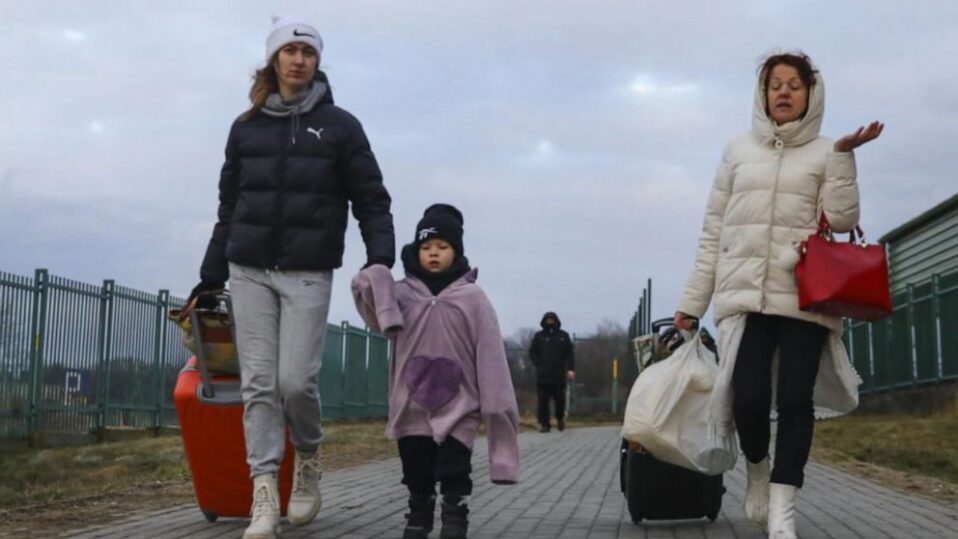
KYIV, Ukraine – When the war started and Russian bombs began falling on Kyiv, missionaries Marie and Japhin John had to decide whether to leave the capital.

“We had our bags packed because, it’s just like you are in rush, and there’s a new situation; all of a sudden, you wake up in the morning, you hear the sound of bombs, so you’re in a rush, and you’re like ‘Wow! What is happening here?'” Marie said. 

“It was not an easy decision until we prayed. But once we prayed, it was a very easy decision,” Japhin added.

Japhin is from India. His wife, Marie, is German. Both are missionaries to Ukraine with the group Youth With a Mission.

“Growing up in India, and also doing ministry in India, this was not my first time being in a dangerous situation, in fact, this is the third time,” Japhin said.

They decided to stay because of a commitment to serve the Ukrainian people, despite the very real danger to their lives.

“We are also, like the commitment in marriage, saying, ‘in good and in bad times,’ we are not only here trying to make an impact when times are favorable. And when everyone is leaving, this is the time when we actually need to stay,” Marie told CBN News.

The heart of Kyiv is now a fortress of concrete slabs, sandbags, and metal structures aimed at stopping Russian tanks. Today half the city has already evacuated. The staff of YWAM Kyiv is focused on ministering to those who are still in the city.

Thirty minutes south, Japhin and Marie sprang into action, turning the sprawling YWAM campus into a humanitarian aid hub.

A ministry worker named Natalia and her two sons work in the kitchen making meals for folks in the neighborhood. “It depends on the day, sometimes there are days when we cook for a thousand people, sometimes 500 or 600,” Natalia said.

While driving to deliver supplies, Katarina, a YWAM missionary from Finland, told us, “The only thought that gave me peace was to go back to Ukraine, so that’s why I’m here.”

“I’m not saying that God was the one who forced me to go to the war zone, or it’s somehow that I didn’t have a choice, I had a choice, that was my choice. My choice was to come here, and God opened the door,” she added.

Katarina evacuated just before the war started, but she returned days later. Now she hits the streets of Kyiv delivering food and other aid supplies to those unable to leave their apartments. Each visit ends with a time of prayer. 

While Katarina makes her daily deliveries, an aid worker named David, who normally handles maintenance on the YWAM campus, is making dangerous missions to evacuate people trapped behind Russian lines.

“Every time when I go to these areas I prepare myself that I might not get out of there. I pray every time. I’m not counting, but I’ve evacuated more than 100 people. I just work and work as long as I can, and as long as God allows me to help,” David said.

In another part of campus, Yuliia, who has been with YWAM for five years, is on the phone taking orders from a nearby neonatal hospital. 

Almost every other day, YWAM campuses in Germany and other European countries ship medical supplies to Kyiv for distribution. 

When they’re not handling day-to-day logistics or sorting through all the supplies coming in from around the world, Japhin and Marie visit elderly homes, bringing food and lots of warm hugs.

One elderly woman said, “We are so bored, but the time flies when you are here. It is so tender, it is something for the soul, it is so pleasant, it is wonderful.”

For Japhin, Marie, and others at YWAM, ministering in Ukraine’s war zone is ultimately about fulfilling a commitment to serve.

“I think it’s not so much about handing out food packages or cooking meals or distributing some humanitarian aid, that is not the main thing God has been preparing me for, because everybody can do that,” Marie said. “But the hard thing to do is to do it while you hear the shelling of bombs and while you see continuously on the news, how in your city, not far away from you, a building is burning and people are dying. But I just do it because of love for the country, and because of commitment, to saying I’m not stepping away. If I feed two people or if I help to feed a thousand people a day, maybe in my heart it does not make a difference, because my commitment to God is just the same.”

Source: CBN NEWS

Read more

A Missionary is also an Intercessor for Nations

The call to be a missionary is a call to the nations; to preach the gospel of Christ healing and deliverance to the nations of the world (Isa 61:1-3). Intercession is the key to accessing the nations of the world and opening them up to the gospel of Christ. How does intercession open up the nation?

Intercession opens up the nations by establishing the God-given spiritual authority of the missionary or believer over the nations.  In Psalm 2:8, God commands us: Ask of me, and I shall give thee the heathen for thine inheritance, and the uttermost parts of the earth for thy possession (Psalm2:8). When we “ask of the Lord” for healing, deliverance, peace of our nations through intercessory prayer, the Lord grants us possession or authority over that land, that is the establishment of spiritual authority.

Once the missionary or believer’s spiritual authority is established over the land, every other power will bow to them and doors to the nation will open. Intercession establishes godly altars. Altars are raised by a consistent practice or invocation in or over a particular place. Therefore, when a missionary engages in consistent intercessory prayer for a particular location, the atmosphere over that location is saturated with the power of God, causing a godly altar to be raised. That altar will speak for that nation, country, or locality for many generations.

Many great men of God have taken nations for Christ and performed mind-blowing miracles through the agency of Holy Spirit-led intercession. One of these great men is Charles Finney who cried- “God give me Scotland or I die”. A missionary cannot achieve anything worthwhile in any country, without first releasing the power and the presence of God into that country through intercessory prayer.  The missionary must engage in intercession before commencing missionary work. Intercession for the nation must continue for the duration of the missions and even after the missionary has departed from that country.

Word of encouragement

Dear missionary, be encouraged to rise in the intercessory prayer for the nations. The Lord has made the grace and anointing for intercession available for every missionary and believer, particularly in this season of unrest amongst the nations. We must ask the Holy Spirit to stir in us this grace and anointing in our lives. We must be like Jesus. We must not relent in our intercessory prayer for the nations. Jesus interceded for his disciples and the world whilst he was on earth. Jesus has not ceased intercession.  Jesus sits at the right hand of the father offering continuous intercession for believers and the world- Therefore He is also able to save to the uttermost those who come to God through Him since He always lives to make intercession for them (Heb 7:25).


We must not hold our peace until the nations come to Jesus- For Zion’s sake I will not hold My peace, And for Jerusalem’s sake I will not rest, Until her righteousness goes forth as brightness, And her salvation as a lamp that burns. (Isa 62:1). Heaven is counting on us to release the power and the presence of the Lord into the nations through our intercessory prayer for the nations.

Written by: Adjoa Ago

Read more

How do you know you have been called to be a Missionary?

Missions is very special service to God. It is God who calls a person to serve as a missionary. In John 15:16, it is written- You did not choose me, I chose you and appointed you that you should go and bear fruit that your fruit should remain….. The starting point of a call to be a missionary is a godly desire to win souls for Christ. It is a desire planted by God and nurtured by the Holy Spirit. We must patiently wait for the Holy Spirit to nurture that desire in our hearts and open doors for the necessary training and mentorship which will equip us for the work of the missionary.

Mentorship is a key aspect of the training to become a missionary. Without mentorship, it will be impossible to be a successful missionary. Mentorship prepares you to handle the challenges on the field, it equips you with practical knowledge about the mission field and the various strategies used in evangelism. Throughout scripture, we see our Jesus mentored the 12 disciples into becoming effective leaders and missionaries. We also see how Apostle Paul mentored Timothy.

Mentorship for missionary work can start with your local church or you can choose to join a missionary organization. You can also read books or listen to sermons or study the lives of people who have been successful at missionary work.

Written by: Adjoa Ago

Read more

Is it a sin to buy a lottery ticket, make a sports bet, spend a little at the casino?

Is it a sin to buy a lottery ticket? What about making a bet at a casino – so long as it’s a budgeted amount of money and made responsibly? How about dropping a sports bet? Is it a sin to gamble?

Some people would argue there is nothing sinful about it. Recently, after posting on Facebook one of my editorials against the legalization of sports betting in the Tar Heel state, a woman said in the comments section: “I’ve never found any basis in the Bible to oppose gambling specifically, even though I have searched.” Another woman wrote, “Nowhere in the Bible does it say gambling is a sin — not one single sentence about gambling.”

Guess what? Those two women were right. One cannot show any place in Scripture where it directly says, “Thou shalt not gamble.” But is the matter that easily dismissed?

The late Dr. D. James Kennedy, a renowned Presbyterian minister, used to counter this argument in favor of gambling by explaining it’s also impossible to find in Scripture where it directly says, “Thou shalt not watch pornography.” Nevertheless, the Bible does talk about the sin of lust and advocates principles that would prohibit doing anything that would entertain, generate, or provide for the means and expression of lust.

The Bible also talks about the sin of covetousness. “Those who cannot see the connection between pornography and lust are not likely to see the connection between covetousness and gambling,” said Kennedy. “The truth is, however, that gambling is a form of the sin of covetousness.”

What is covetousness, one might ask? In short, covetousness is an inordinate desire for wealth and possessions or someone else’s possessions.

Rex Rogers, in his book Seducing America, rightly says there are only three ways to legitimately acquire property: 1. as a gift, 2. as a payment for labor, and 3. in fair exchange. Anything else is covetousness and gambling certainly doesn’t fit any of these criteria.

Covetousness is a violation of the 10th Commandment of God, “Thou shalt not covet …” (Exodus 20:17). Gambling flows from a spirit of avarice and greed. This is what makes it so exciting and addictive. It stirs up what is depraved in human nature and can make a person lose their way. Gambling is born of the burning desire for quick earthly riches.

Thus, the Scriptures provide strong warnings about covetousness. Jesus said, “Take heed and beware of covetousness: for a man’s life consists not in the abundance of the things which he possesses” (Luke 12:15). The apostle Paul admonished, “But those who want to be rich fall into temptation, a trap, and many foolish and harmful desires, which plunge people into ruin and destruction. For the love of money is the root of all kinds of evil, and by craving it, some have wandered away from the faith and pierced themselves with many pains” (I Timothy 6:9-10).

Many other principles in the Bible indict and condemn the practice of gambling:

  • Love of one’s neighbor. Jesus commanded, “Love your neighbor as yourself” (Mark 12:31). Gambling is predicated on the losses, pain, and suffering of one’s neighbor.
  • Exploiting the poor and vulnerable. Gambling preys on the desperation of the poor. Based in Washington, D.C., Stop Predatory Gambling notes that “[s]tate governments concentrate lottery outlets in economically-distressed regions to entice more citizens from the lower rungs of the income ladder. Lotteries are pushing scratch tickets as high as $50 in low-income communities to citizens who earn a minimum wage of $7.25 an hour in those same states. It takes seven hours of work to lose it all on a $50 ticket.” The prophet Isaiah said, “The Lord brings this charge against the elders and leaders of his people. Why do you crush my people and grind the faces of the poor?” says the Lord God of hosts” (Isaiah 3:14).
  • A strong work ethic. God has designed work as the proper means for humankind to supply their needs and provide for their loved ones. Gambling undermines the work ethic and touts the false hope of something for nothing. Genesis 3:19 makes it clear that from the beginning of time God ordered that mankind earn his bread by the “sweat of his brow” — meaning hard work. This principle is so important in the New Testament dispensation that II Thessalonians 3:10 reads, “If anyone isn’t willing to work, he should not eat.” Syndicated columnist George Will summarized it this way: “The more people believe in the importance of luck, chance, randomness, and fate, the less they believe in the importance of stern virtues such as industriousness, thrift, deferral of gratification, diligence, and studiousness.”

    There are numerous other ways gambling runs afoul of the Bible’s teachings. God requires good stewardship of one’s possessions. Jesus alluded to this in the parable of the talents (Matthew 25:14-30). Generally speaking, gambling is a waste of one’s resources that could have been put to good use. The games are rife with deception, concealing or misleading people about the odds. The Psalmist said the Lord would destroy those who tell lies, and he abhors those who deal treacherously (Psalm 5:10).

    Moreover, state-sanctioned gambling undermines the God-ordained purpose of government to suppress and judge evil (Romans 13:1-5). The state does just the opposite by allowing the citizenry to be fleeced and victimized by gambling.


    Its most unfortunate churches often promote gambling by using games of chance for charitable purposes. They say the end justifies the means. Gamblers sometimes rationalize making their bets by noting that churches have bingo games, raffles, etc. Churches, however, and Christians in general, should be setting the right example by not participating in any kinds of gambling. Of all those who should demonstrate that we should keep free from the love of money and be content with what God has provided (Hebrew 13:5), it’s the people of God.

    Indeed, the Bible may not say, “Thou shalt not gamble.” Still, God’s Word is filled with precepts and principles that unquestionably condemn the practice as sinful. It doesn’t matter whether the money wagered was deemed a responsible bet or not. When one gambles, it is a covetous act that is participatory and complicit in a baneful enterprise that shares in the guilt of many other sins.


Read more

Jihadists Attack Christian Community, Burn Down Church

01/07/2022 Nigeria (International Christian Concern) –  The Islamic State West Africa Province (ISWAP), the ISIS-backed offshoot of Boko Haram, attacked Wultihiya, a predominantly Christian community in Nigeria.

Local sources told SaharaReporters that the attack occurred Thursday without government intervention, forcing residents to flee into the bush. A church, two cars, and several homes were burned down in the attack.

Terrorist groups such as ISWAP have killed tens of thousands of Christians in Nigeria and displaced millions in an attempt to discard western influence and impose strict Islamic Sharia law.

“ISWAP, which split from the mainstream Boko Haram in 2016, has become a dominant group, focusing on military targets and high-profile attacks, including against aid workers,” wrote Sahara Reporters. “The Nigerian army has repeatedly claimed that the insurgency has been largely defeated and frequently underplays any losses.”

Source: International Christian Concern

Read more

Ex-Porn Star now a Pastor with a family shares his story

Ex-porn star Joshua Broome is now a husband, father, and pastor, sharing his journey out of the adult film industry.

Broome opened up this week on his “Counterfeit Culture Podcast” about his relationship with his wife, Hope, who appeared alongside him to talk about their love story.

He discussed how the two met and how Hope, a lifelong Christian, showed him grace and understanding as she learned details about his complicated past.

“[Hope] met me where I was. She extended grace and God started radically moving in my life,” Josh said. “It’s because I gave my life to Jesus so early on in our relationship, and we started growing together.”

One of the most compelling parts of the discussion was when Josh asked Hope how she could move forward so boldly after he revealed his past as a porn star.

“People ask me this so often, and for the longest time, I wasn’t sure what the answer was,” Hope said.

She said a college student said something last year that helped her recognize that God’s goodness was behind her ability to look past Josh’s past.

“[The] student was like, ‘Well, obviously it was the Holy Spirit,’” she recounted, noting that this simple recognition sparked a realization. “And I was like, ‘You are so right.’”

Hope admitted her calm reaction to something so shocking was a bit out of character, but it helped her see an essential reality about God’s love and forgiveness.

“My response was, ‘If God can forgive you, why can’t I?” she said.

Hope said it wasn’t difficult to fall in love with Josh. She never knew him during his time in porn, and most of the build-up at the start of their relationship was predicated upon the everyday issues normal couples face.

“I never knew you as that person,” she told Josh. “We just went through the same things I felt like everybody does.”

There were, of course, some unique challenges along the way. One of the more challenging parts of the journey was the reality that the hundreds and hundreds of videos Josh appeared in are still available on the Internet – and he has no control over it.

Some online bullies and trolls have intentionally sent these to Hope and have tried to harass her with them. But she has learned how to navigate that unfortunate reality.

“It will randomly happen, and I try my best to not dwell on it,” she said. “When it would first happen, it would sit there and linger in my mind.”

Now she deletes, blocks, and ignores.

“I have so many other things that my brain space needs to be holding,” she said. “That is not one of them.”

As for Josh — a Christian pastor who contends with the ongoing existence of this content online — he said he prays it is one day gone. Either way, though, he handles it with grace and reliance on the Lord.

“I pray to God that everything is eradicated off the Internet and that just doesn’t exist anymore,” he said. “That is my prayer, but if that doesn’t happen, I have no choice but to deal with it.”

Source: Faithwire

Read more

A man in Kenya arrested for stealing Bibles, Claims he wants to use them for evangelism

A Kenyan man identified as Augustine Wanyonyi has been busted for stealing two bibles from a municipal supermarket and his defense is amazing.

He appeared before Milimani Chief Magistrate Susan Shitubi and defended that he developed suicidal thoughts hence wanted to learn more about God and his words which led him to steal the Bibles.

According to him, he had a firm faith that the word of God would break his bondage after State Counsel Alice Mathangani read a police statement in court revealing that he went to Naivas Supermarket on Moi Avenue in Nairobi on Monday, January 30th, around 3:00 pm and stole two bibles and hid it inside his pants.

Reports suggest that he was caught on a CCTV camera on the premises and was arrested after refusing to pay more for the product.

Court documents disclosed that the 30-year-old man developed suicidal thoughts after a fire engulfed his home in the Mukuru Njenga slum.

When asked why he stole two bibles he asserted that he wanted to give one to his wife and use the other.

He said, “I stole the Bible so that I could read, understand and preach the word of God instead of committing suicide due to problems I’m facing”

Source: The Standard

Read more

A Ghanaian couple have finally given birth to quadruplets after 15 years of marriage

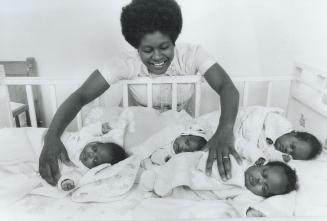
A couple, married for 15 years without children, have finally given birth to quadruplets, two females and two males.

The father, 66-year old Pensioner, Peter Afriyie Kwarteng, and the wife, Joana Antwi are appealing to individuals and philanthropic organizations to come to their aid, either in cash or in kind to enable them to successfully raise the 4 babies.

GBC’s Nicholas Osei Wusu reports that sixty-six-year-old Pensioner, Peter Afriyie Kwarteng and his wife, Madam Joana Antwi, had been married for 15 years without a child.

Their first child after the marriage did not survive.

The couple then had to wait for about 13 more years for divine favour to bear children of their own.

Madam Joana Antwi, an Orderly at the Abofour Health Centre shared with GBC News the challenging and embarrassing moments she had to endure.

”It was difficult for me and my husband during the multiple years of childlessness.”.

For a greater part of the gestation, Madam Joan Antwi  was detected through a scan to be carrying triplets.

As the pregnancy progressed, it was detected through scan that she carried quadruplets.

Madam Antwi eventually gave birth to pre-term babies, two boys and two girls through a Caesarian Section when she was 46 years.

Though husband and wife, Peter Afriyie Kwarteng, a retired worker of the Railways Corporation, and Madam Joana Antwi are grateful to God for giving birth to children of their own, they are quite anxious about the  socio-economic difficulties associated with such a fortune.

Apart from having to budget for themselves, in the last 15 years, they have had to expand the budget size to cater for additional 4.

What has become an additional burden to them is the fact that their rent has expired.

They are presently living in a single room at Offinso Asamankama in the Offinso South Municipality of the Ashanti region and now at the mercy of the landlord.

Quadruplets after 15 years of marriage without children
Mr. Peter Afriyie Kwarteng(in smock) receiving th cash donation from Mr. Jeremiah Seidu, in ‘T’ Shirt) while Madam Joana Antwi, with one of the babies feeding, looking on.

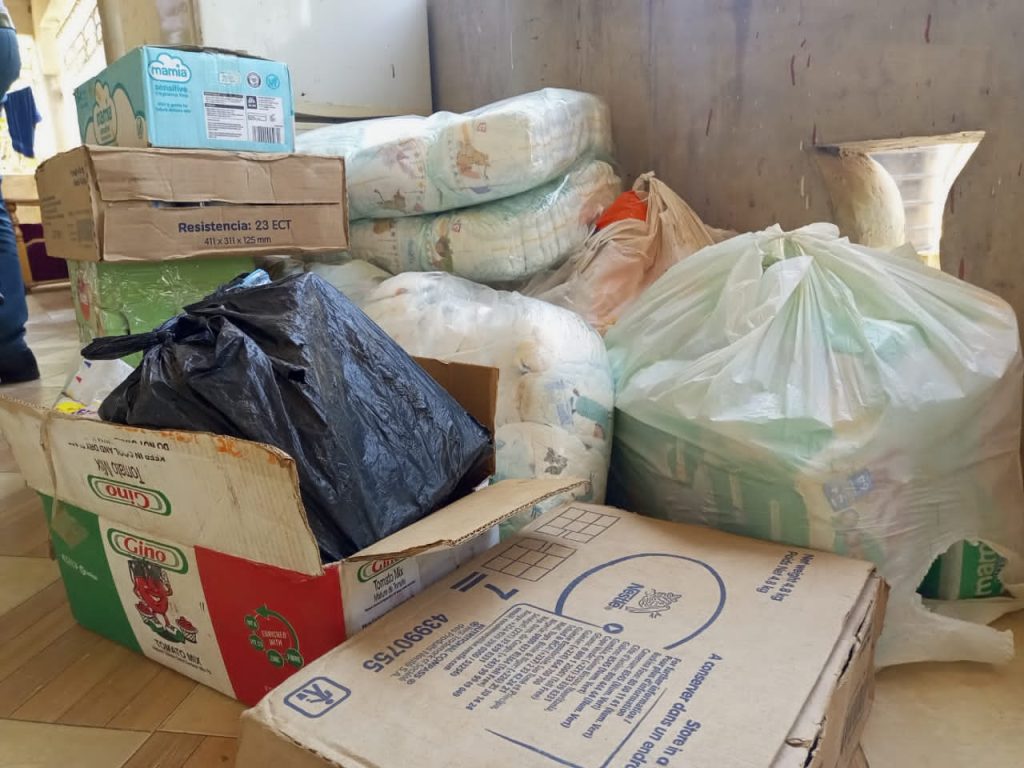
It is in response to such request that Sisters Keepers Ghana, a Humanitarian Group with the support of some individuals including the Deputy Chief Executive Officer of MASLOC and in partnership of a Bole-based Human Development NGO, JAKSALLY presented assorted items made up of a quantity of baby foods, diapers, wipe, playing toys, rice and tomato puree and cooking oil in addition to a cash of GHC 3,60000 Cedis to the couple.

CEO of JAKSALLY, Jeremiah Seidu, personally transported the gifts from Tamale for presentation to the couple.

He explained that children are assets to society, hence the need for everyone to pitch in, in support of the needs of the family.

Donation

The couple are appealing to  well-meaning individuals and organizations to come to their aid so as to lessen their economic challenges.

Source: GBC

Read more